Ari Atoll is one of the largest and most celebrated diving atolls in the Maldives, a 40-km-long ring of more than 50 dive sites built around submerged pinnacles (thilas) and channels (kandus) rather than a continuous barrier reef. Its southern rim holds the South Ari Marine Protected Area, one of the few places on Earth where whale sharks aggregate year-round.
Destination info
Conditions, highlights, and the resident marine life.
Conditions
Water and air temperature across the year.
WaterAirDryShoulderWet
Description
Ari Atoll (administratively split into Alifu Alifu and Alifu Dhaalu) lies in the central Maldives, roughly 80-95 km west-southwest of Male. Its diving is defined by isolated thilas (submerged coral pinnacles) and kandus (channels) where tidal currents concentrate plankton and draw large schools, reef sharks, eagle rays and pelagics; the atoll is famous for high-energy thila dives such as Maaya Thila, Fish Head and Kudarah Thila, several of which are among the Maldives' oldest protected marine areas. Two monsoon-driven seasons shape conditions: the northeast monsoon (Iruvai, roughly December-April) brings flat seas, clear water and peak manta-ray cleaning-station activity, while the southwest monsoon (Hulhangu, roughly May-November) pushes nutrient-rich water that boosts whale-shark feeding along the southern reefs. Water temperature is warm and stable year-round at about 28-29 degrees Celsius, with visibility typically 15-30 m depending on site and season. The 42-km-squared South Ari Marine Protected Area, designated in 2009 off Maamigili and Dhigurah, hosts a resident population of 60-100 mostly juvenile male whale sharks and has the highest whale-shark re-sighting rate of any hotspot in the world. Currents at the exposed thilas can be strong, so the headline sites suit experienced divers, while sheltered reefs and the whale-shark zone welcome beginners and snorkellers.
Highlights
What makes this dive worth the trip.
The South Ari Marine Protected Area (SAMPA) covers 42 km-squared off Maamigili and Dhigurah and was officially designated in 2009. A peer-reviewed valuation study documented a resident population of roughly 60-100 mostly juvenile male whale sharks present year-round, making it one of the only locations on Earth with year-long whale-shark residency.
SAMPA has the highest re-sighting rate of any whale-shark hotspot in the world: the same individuals are repeatedly identified by their unique spot patterns, and the predominant behaviour observed is slow cruising near the surface, giving snorkellers and divers reliable, calm encounters.
Ari Atoll's diving centres on thilas (submerged pinnacles) and kandus (channels) rather than a barrier reef; tidal currents flowing through these features concentrate fish, reef sharks and eagle rays, and several sites (Maaya Thila, Fish Head and Kudarah Thila) are among the Maldives' oldest and most successful protected marine areas.
Marine life
49 species you’re likely to encounter on a dive here.
Dive sites
7 signature sites at this destination.
Maaya Thila
A roughly 80-m-diameter submerged pinnacle in North Ari, repeatedly ranked among the very best dive sites in the Maldives and protected as a marine reserve. The reef top sits around 6 m and the flanks drop past 30 m, with a notable swim-through near 24 m. By day the site is patrolled by white-tip and grey reef sharks circling the pinnacle, with turtles, batfish, blue-faced angelfish, fusiliers and blue-stripe snapper schools; it is also one of the atoll's premier night dives, when hunting whitetips, morays and stonefish become active. Currents are highly changeable, so divers circle the pinnacle in the lee of the flow under guide direction.
6–30 mintermediateDay boatModerateVisibility 15–30 m
Fish Head (Mushimasmingili Thila)
An oval pinnacle roughly 100 m by 60 m in North/central Ari, lying almost due east of Himandhoo, and one of the Maldives' first and most successful protected marine areas. The reef top is around 10 m and steep coral-covered walls, overhangs and caves drop past 35 m. It is famous as a top-tier shark dive: a resident population of roughly 16-20 grey reef sharks patrols the site daily, beneath dense schools of blue-line snapper, fusiliers and batfish, with giant trevally, barracuda and large Napoleon wrasse on the walls. Currents are moderate to strong and best dived November-April; advanced certification and good air management are recommended.
10–40 madvancedDay boatStrongVisibility 15–30 m
Kudarah Thila (Kuda Rah Thila)
A small but spectacular pinnacle in South Ari, designated a marine protected park in 1995 and often called the most famous dive site in South Ari. Four coral heads rise from a plateau at about 12 m and drop to 30-40 m, framed by caverns, large gorgonian sea fans and black coral with soft pink and orange corals. The protected status shows in the fish density: enormous schools of blue-striped (five-line) snapper, sweetlips, batfish and groupers gather between the heads, joined by white-tip and grey reef sharks, turtles, Napoleon wrasse and eagle rays. Currents are often strong, demanding a rapid descent and an open-water safety stop.
12–40 madvancedLiveaboardStrongVisibility 15–30 m
Fesdu Wreck
A 30-m steel fishing trawler resting on a gentle sand slope beside a small thila in North Ari, sitting in roughly 18-30 m of water. Now thickly encrusted with soft corals and sponges, the wreck shelters dense clouds of glassfish, plus anthias, lionfish, groupers, morays and the occasional frogfish, making it a relaxed second or afternoon dive often paired with the neighbouring thila. Currents are typically light (under 1 knot), and the moderate depth and calm conditions suit intermediate divers and underwater photographers.
18–30 mintermediateDay boatLightVisibility 15–30 m
Broken Rock
A distinctive oval coral pinnacle in the Dhigurah kandu, the channel between Dhigurah and Dhangethi in South Ari, named for the deep canyon that splits the reef in two. The top reef begins near 12 m and the site reaches about 30-36 m. The headline feature is a narrow gully or tunnel through the centre of the rock, its walls draped with gorgonians, sponges and soft corals; divers swim through it, taking care not to be pushed against the formations when current runs. Reef fish, sharks and larger pelagics work the channel, and whale sharks pass the nearby outer reef seasonally.
12–36 mintermediateDay boatModerateVisibility 15–30 m
Maamigili Beyru (Whale Shark Point)
The signature whale-shark site of the South Ari Marine Protected Area, running along the outer reef off Maamigili Island (with Dhigurah marking the eastern end of the protected zone). It is a long, gently sloping fringing-reef drift between roughly 5 and 30 m, suitable for all levels and for snorkellers. Whale sharks, mostly juvenile males of 4-8 m, cruise near the surface year-round, with an estimated 80 percent sighting probability on a given day; the area is also reliable for mobula and reef manta rays, blacktip and grey reef sharks, eagle rays, spinner dolphins and Napoleon wrasse. Conditions are mild to moderate, with excellent visibility in the dry season.
5–30 mbeginnerDay boatLightVisibility 15–40 m
Moofushi Manta Point
A manta cleaning station on the eastern corner of a large plateau south of Moofushi Island in central Ari, where a prominent coral block sits at about 16 m and the site reaches around 30 m. Reef manta rays glide in to hover over the block while cleaner wrasse service them; the season runs roughly December to April, with multiple mantas often present on a single dive. Currents are light to medium and the site is accessible to most certification levels, making it one of Ari's most reliable manta encounters. White-tip and grey reef sharks and Napoleon wrasse are commonly seen alongside the mantas.
12–30 mbeginnerDay boatLightVisibility 15–30 m
Where to dive & stay
1 operator at this destination.
Pinnacle
MV.Salvora
Liveaboard
DivingRoomsCoursesRestaurant
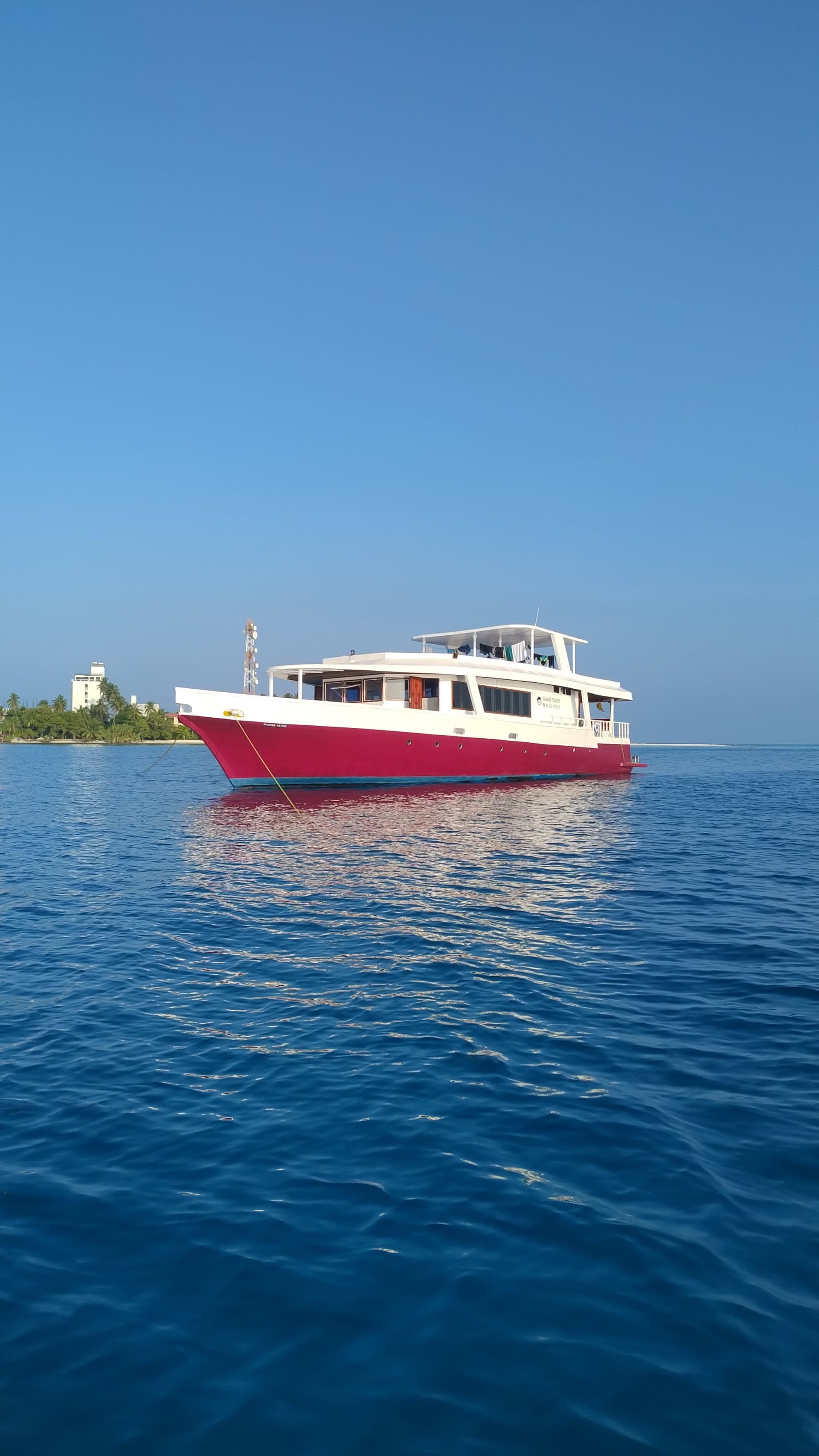
MV. Salvora offers authentic, value driven Maldives diving with small groups, flexible personalized trips delivering uncrowded dive sites, rich marine encounters and Maldivian hospitality.